
|
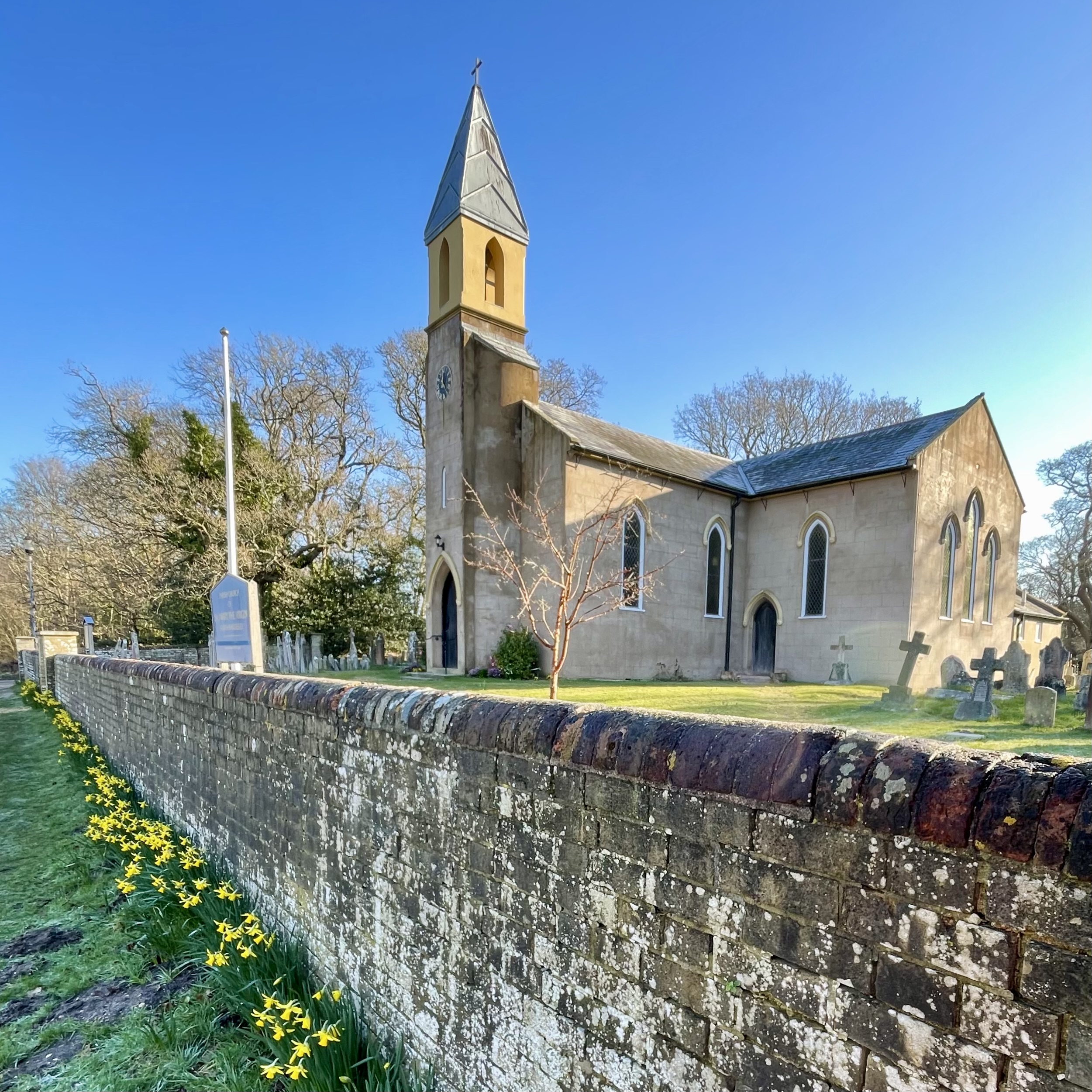
The story of St. Mary's Church South Baddesley Hampshire By E. J. Hartwell THE HISTORY - The parish church of St. Mary came into existence when the parish of South Baddesley was formed out of Boldre parish in 1858. At that time a small chapel that had stood on this site for about forty years was enlarged to form the present church. This smaller chapel was itself the successor to an earlier building very near to Pylewell House that was demolished in 1819; and that chapel, built in or about 1731, replaced an ancient chapel dating back to the 14th Century. Our story starts then with the origin of this medieval building. Tradition has it that the Knights Templar, and later the Knights of St. John, owned a preceptory at South Baddesley; but there appears to be no evidence for this. On the contrary, it seems clear that the story arises from a confusion between South and North Baddesley, where a preceptory certainly did exist. Moreover, our knowledge of the history of South Baddesley chapel, which can reliably be traced back to the early years of the 14th Century, does not seem compatible with the presence here of military knights. For it is known that in 1316 Henry de Welles, Lord of the Manor, applied for permission to build a chapel at South Baddesley on the grounds that it was so difficult for the parishioners to make the three mile journey to church at Boldre over bad roads. This chapel, dedicated to the Virgin Mary, was built by 1329, and included a chantry where Mass was said for the soul of the founder. A century later, in 1429, the advowson, which implies the right to appoint the priest, was said to belong to John Lisle, Lord of the Manor of South Baddesley; but by the reign of Edward Vl (1547-1553) this right seems to have been lost, for in 1546 a survey reported that Nicholas Barnard, Vicar of Boldre, was acting as Chantry Priest at South Baddesley. At this time the endowment was valued at £4. 2s. 9d., of which the inhabitants were paying £2. 2s. 8d. 'of their only good will to have ministration there'. It has been suggested that, at the time of the Reformation in the 16th Century, the role of South Baddesley chapel as a chantry gave the excuse for its endowment to be seized by the Crown; but for whatever reason the building then fell into decay, and it was not until the 18th Century that the chapel was rebuilt. By this time the Pylewell estate and the Lordship of the Manor of South Baddesley were in the hands of the Worsley family, who had also held the Baronetcy of Appeldurcombe in the Isle of Wight since 1611. A conveyance of 1741 by James Worsley, later to be the 5th Baronet, states, whereas the said James Worsley at his own costs and charges have lately erected and built at South Baddesley within the parish of Boldre a chapel - and has also set up and erected convenient pews and seats within the same for the more commodious attending of divine service and to the end that the said chapel may be supplied by persons of learning and good life'. This chapel was built on a slight mound about 130 yards north west of Pylewell House, probably very near the site of the ancient chapel. The Worsley chapel may well have been erected in 1731, for that is the date of our church bell, perhaps the only surviving relic from the old chapel. We know that in 1741 the chapel was endowed with an annuity, 'charged on certain lands at Baddesley, of £12 to keep the chapel and pews or seats in repair, to find books for the minister and clerk, a surplice for the minister, and the residue to the minister for the time being. Occupiers of seats had to raise a total of £10 yearly, and those who paid most had the best seats. If the £10 was not raised, the minister was not required to perform any services. Service was only once a day on Sundays. The Pylewell estate remained in the hands of the Worsley family until 1781, when it was sold by the 7th Baronet to Ascanius William Senior. He in turn sold it in 1787 to Thomas Robbins, whose name appears as the owner on Milne's map of 1791 (q.v.). In 1801 it was acquired by a celebrated Roman Catholic family, when Thomas Weld bought the estate for his son, Joseph. Joseph Weld achieved national fame as a yachtsman, and was a founder member of the Royal Yacht Squadron. A distinguished designer of yachts, including the Arrow, the Alarm and the Lulworth, he has been described as 'the father of yachting' and was one of the founders of the sport at Lymington. It was no doubt this strong interest that brought him to Pylewell, and some of the boats that he made famous were partly built at Pylewell Hard on the Solent shore of the estate. He maintained a Roman Catholic priest for his private chapel within the house, and his son, also called Joseph, was later responsible for building the Roman Catholic church in Lymington, the architect being Joseph Hansom, the designer of the Hansom cab. In about 1818 there began at PylewelI a major programme of improvements to the house and grounds. It was the fashion of the time that every country house worthy of note must enjoy the privacy of its own parkland. To create such a park it was necessary to move the village of South Baddesley from the site it then occupied 400 yards north of Pylewell House, to demolish Baddesley Manor, the old manor house that stood near the centre of the village alongside Dodd's Pond, and to move the Lymington to East End road from the front of Pylewell House to its present route at the northern boundary of the park. The villagers were rehoused, a new chapel was built for them on the site of our present church, and the Worsleys' chapel was demolished. For this purpose a faculty was required from the Bishop of Winchester. This faculty refers to a 'chapel of ease in the parish of Boldre built for the convenience of the Parishioners, a plain rectangular brick building 44 feet by 20 feet in the clear, exclusive of the belfry'. The Bishop seems to have had doubts whether the new building would be of greater convenience to the parishioners, but the observers whom he sent to South Baddesley, discovering no doubt that the village had already been moved, reported back that it would indeed be so. The new building was still at this stage only a chapel, the minister being prohibited from performing any of the sacraments there. The chapel was assigned by deed of gift in 1819 by Joseph Weld to the Revd. Henry Adams of Beaulieu, son of the Master Builder at Buckler's Hard. There is at certain irony in the fact that this appointment was made by a Roman Cathoilc even before the main Act of Catholic Emancipation passed through Parliament in 1829; indeed it is doubtful whether to this day a Catholic may lawfully present or nominate to a benefice in the Church of England. Forty years later, in 1858, the new chapel was to become a parish church for the first time. By then Pylewell was the property of William Peere Williams-Freeman, who enlarged the chapel by adding a chancel and transepts to make the present cruciform shape, and endowed it as the parish church of South Baddesley, East End and Norley Wood - an ecclesiastical parish formed from the civil parish of Boldre. The first incumbent was Josiah Norton, the parish register dates from 1858, and the first burial took place in the same year. For almost a century South Baddesley had a vicar with no other parish in his charge, until, in 1954, the benefice was united with East Boldre. More recently, in 1982, a restructuring of neighbouring parishes led to the joining of South Baddesley with Boldre, also as a 'united benefice', i.e. as two independent parishes in the charge of a single vicar. Meanwhile, the Pylewell estate together with the lordship of the manor had passed after the death of Williams-Freeman in 1874 to the Whitaker family. The first William Ingham Whitaker came here in 1875. He built the village hall opposite the school which had been built earlier by Williams-Freeman, and provided generously in his will for the maintenance of the church. His son, the second William Ingham Whitaker, also took a strong interest in South Baddesley church, and his grandson, the third William Ingham Whitaker, was churchwarden here for fifty years. He died a bachelor in 1988, and was succeeded by his nephew, the twentieth Baron Teynham.
CONTINUED
|
|