
Boldre and South Baddesley Benefice, Church of St John the Baptist

HISTORY OF THE CHURCHES IN THE BENEFICE OF BOLDRE AND SOUTH BADDESLEY

St. Mary's Church (Continued)
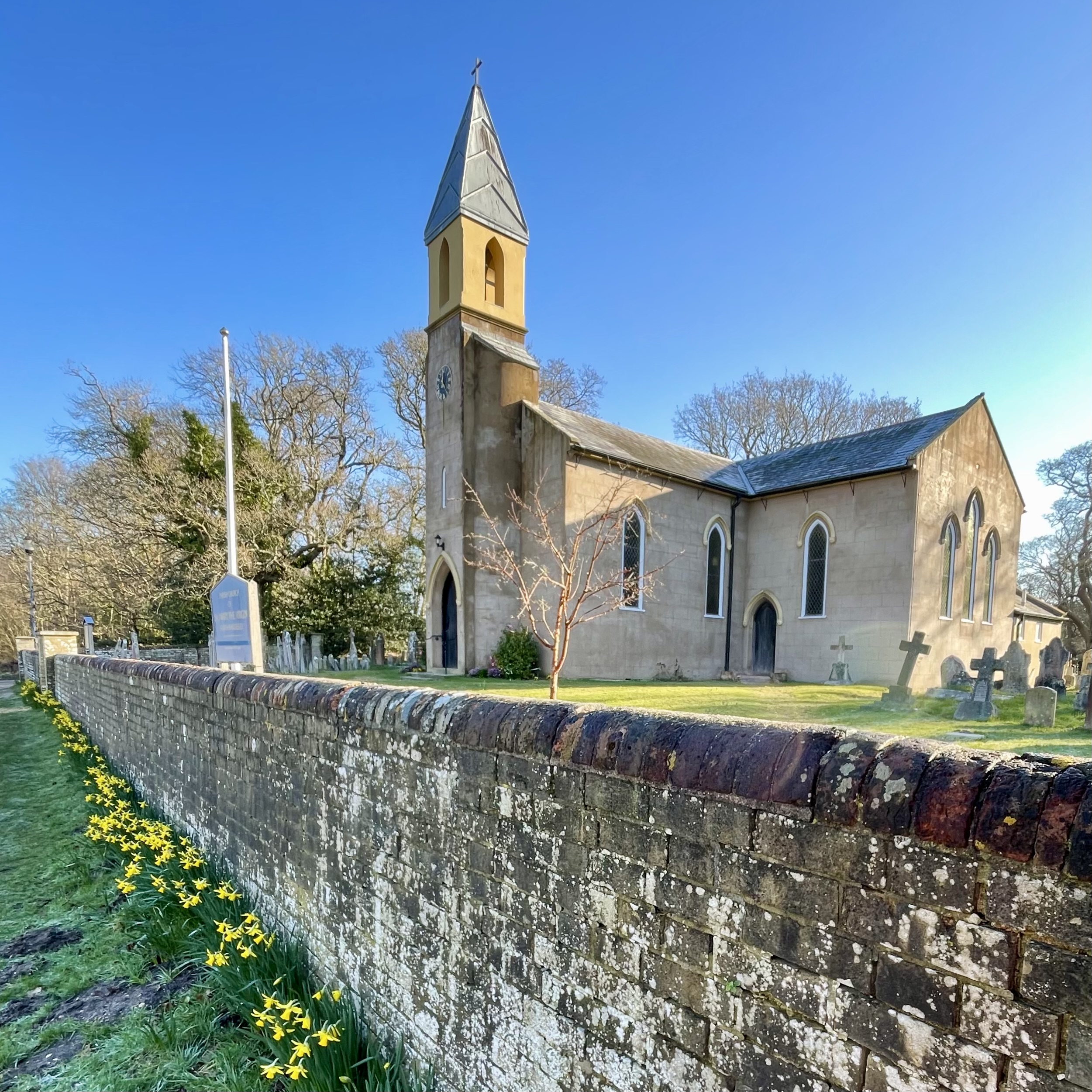
THE FABRIC AND INTERIOR - The influence of Pylewell is, of course, apparent in a great many features of the building and its contents. The bricks used in building it and the hexagonal tiles on the floor of the nave were made at Pitts Deep in the brickyard of the PylewelI estate. The lectern and the altar cross were given in memory of the first William Whitaker; and the pulpit and panelling of the chancel, both made by estate employees from homegrown oak, and the sanctuary lamp are memorials to his son. So, too, is the reredos behind the altar which consists of 'material used in Westminster Abbey at the coronation of King George Vl and presented to St. Mary's Church by Her Highness Princess Marie Louise as a memorial to William Ingham Whitaker who died on July 10th, 1936`. The cushions and kneelers in the front pews were worked by his widow, Hilda, and the kneelers at the altar rail, with the views of Pylewell House in petit point, by his daughter, Elspeth. There are reminders, too, of the Whitaker family on the brass memorial tablets, while in 1990 donations given in memory of the third William Whitaker made a large, timely and extremely welcome contribution to the renewal of the roof of the nave.
Others also have their memorials. The candlesticks on the altar were given by Robert Dell, vicar from 1893 to 1907, and his wife, the tablet on the south wall of the nave pays tribute to three generations of the House family who were vergers. The altar and panelling in the south transept were carved by Mr. S. C. Wooldridge, a parishioner and a Lymington shipwright, to commemorate his son who was killed in a road accident; and the display case on the west wall is a memorial to David Goddard, vicar from 1963 to 1978, who is remembered with special affection by the people of South Baddesley. The organ, built by Bryceson Brothers about 1883, was renovated in 1947 in memory of Frederick Canterbury, for 48 years organist and choirmaster here; the wrought iron lamp brackets on either side of the chancel arch are also a memorial to him.
The stained glass window in the north transept was installed in 1948 as a memorial to Dorothy Banks, wife of Sir Donald Banks, KCB, DSO, TD, who served with distinction in the first world war, was Defence Commander for Hampshire in the second, and among other varied appointments became the first Director General of the Post Office in 1934. The window shows a Madonna and Child with adoring animals, and the designer, Arthur Buss, now in his eighties, was later responsible for the design of the massive west window at Lancing College, said to be the largest rose window in the country. A second stained glass window, to be found in the sanctuary, is less conspicuous but very attractive in its own way, with its miniature Last Supper depicting only five disciples; while a third window, that in the west wall of the nave, is curiously placed, since the belfry beyond allows very little light to enter through it. This might suggest that the belfry was a later addition, were it not for the fact that there is mention of the belfry in the faculty of 1818 giving the Bishop's approval for the building of the new chapel.
An interesting and unusual feature of the church is the pierced chancel arch, 'fretwork tracery rustic and jolly', as Pevsner described it, with its decorated inscription.
At one time there were other similar inscriptions round the window arches of the nave, but these were removed about 1960. Another unusual feature is the construction of the domed ceiling at the crossing, which is suspended from a large metal wheel mounted above. This part of the church sustained serious damage in February, 1974, when an elm tree crashed on the roof during a storm. The building became unsafe for worship, and for more than two years the services were held in the village hall. Repair on this scale was a major undertaking for a parish of this size, with only about eighty people on the electoral roll; but in January, 1976 a roof appeal was launched and raised £4,000 in three months. The work was done, an heroic effort by Mr. F. C. Keeping, and the church reopened with a service attended by the Bishop of Winchester in October of that year - a remarkable achievement by all concerned.
It will be noticed that there are two entrances to the church: that in the south transept was intended for the use of the Lord of the Manor and his family, while the other at the west end gives access to the nave through the porch. Above the porch is the belfry which now contains a single bell bearing the inscription, "WM TOSHER CAST ME IN 1731". This bell was presumably transferred from the earlier Worsley chapel when that was demolished in 1818; and, as was mentioned earlier, may well give us a date for the building of it. The bell was cast by William Tosier (spelling does not seem to have been among his accomplishments) and was one of the last bells to be made at the Salisbury foundry where bells had been cast throughout the years from 1580 to 1733, the last bell of all being made in that year for St. Michael's Church, Southampton. The South Baddesley bell is older than any bell at Boldre or Lymington. In 1990 it was renovated and remounted by David Wooldridge in memory of his grandfather, Sydney Charles Wooldridge, who carved the altar in the south transept.
The clock in the belfry is now electric, but the mechanism that was removed in 1950 was restored by an enthusiast for presentation to the museum at Colchester. It is dated 1767, was made in Colchester by Nathaniel Hedge for St. Nicholas' Church, Colchester and probably came to South Baddesley about 1920.
St. Mary's Church is built of bricks from the Pylewell brickyard at Pitts Deep. Made from the green clay that is found there, the bricks - and the tiles on the floor of the nave - have a characteristic yellow colour to be seen in walls and houses in the area. Unfortunately, the bricks used in building the church do not appear to have been of high quality; the layer of render with which they are faced was presumably necessary to keep out the weather, but is certainly not an attractive feature of the building.

THE CHURCHYARD
- The graveyard came into use when the ecclesiastical parish was formed in 1858. The earliest grave, to be found near the centre of the plot on the south side of the church, is that of Edmund Perkins, who was buried on the 20th July, 1859 by the first vicar, the Revd. Josiah Norton. Among other early graves of interest is that of John Bond, a policeman from East End, who died in 1861, marked unusually by an iron memorial, to be found in the south east corner of the south plot, and made, it seems likely, at Sowley ironworks. In this earliest section of the graveyard are buried many Pylewell Estate employees whose relatives were unable to afford the cost of a memorial stone. Their graves are marked anonymously by stones provided by the estate bearing only the inscription ' R. I . P.'
The graves of the Lords of the Manor and their families are situated in the south west corner of the graveyard. Their memorials include two, those of the first William Whitaker and of his mother, Eliza Sophia, that are specially fine examples of carving in marble by Italian craftsmen, reminding us of the family connection with Palermo. In a separate plot lie the ashes, together with those of her maid, of Margaret Emily Georgina Whitaker, second wife of the first William Whitaker. She was the daughter of Admiral Sir George Rose Sartorius, GCB, whose tombstone with its anchor and chain is a fine example of Victorian funerary art. The Admiral, who fought at Trafalgar and was later in charge of the Portuguese navy, had two sons who were both awarded the Victoria Cross. One of these, Major General Reginald William Sartorius, is buried near his father.
With the passage of time the graveyard has twice been enlarged by gifts from the Whitaker family of two further pieces of land to the east of the church. These additions are marked by boundary stones. At the north end of the nearer plot are the graves of the Duplessis family, former owners of Newton Park. In the further and later, plot is a modern gravestone, designed by Michael Kenny ARA, in memory of Robin Campbell, DSO, CBE, a former Director of Art with the Arts Council. The headstone is a symbolic representation of a chalice, while the horizontal section includes a circle, the symbol of wholeness, and a shape that recalls the gothic window and vault.
A humble church of modest architectural pretensions, St. Mary's at South Baddesley has a special place in the affections of those who know it well and who worship here. Perhaps its most endearing quality is its quiet woodland setting in a part of the New Forest that remains as peaceful as it is unspoiled.

VICARS OF SOUTH BADDESLEY
1858-1865 JOSIAH NORTON
1865-1870 JOHN BENWELL SEAMAN
1870-1876 EARNEST PEERE WILLIAMS-FREEMAN
1877-1892 JOHN WILLIAM HALL
1893-1907 ROBERT DELL
1907-1913 CHARLES ABDY BRERETON
1914-1916 BERNARD McNAUGHTON HAWES
1917-1946 RANDOLPH LLEWELLYN HODGSON
1946-1951 AUSTIN LOWELL BRYAN
1951-1953 FREDERICK CYRIL AUBREY COMBER GRlFFITHS
1954-1959 FREDERICK HENRY COLLINS
1960-1963 RONALD BERNARD BLOUNT
1963-1978 DAVID IVAN GODDARD
1978-1982 ARNOLD JOHN LEE
1982-1994 JULIAN RICHARDS
1994-1996 GORDON WATTS
1997- MALCOLM RICHES