
|
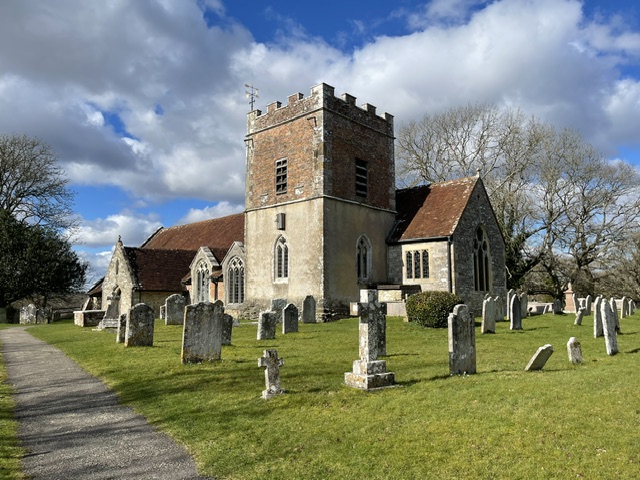
THE WEST END - Windows. The South Aisle at its west end contains a small window by Alan Younger, the Taylor window. It bears the inscription "In memory of lona Taylor and her life of service". Iona Taylor was Girl Guide County Commissioner for Hampshire and amongst other emblems at the foot of the window appears the Girl Guide trefoil. The three white vertical lines of the window symbolise the Trinity; the twelve small gold circles of light represent the twelve apostles; the darker blues form a cross shape and in the centre is a rich burst of summer and harvest colours representing God the Creator. It was dedicated in 1980. Alan Younger also designed the de Mowbray East Window. The West Window, depicting Faith, Hope and Charity, was made by Ward & Hughes of London and inserted in 1864, in memory of Charles Winston, barrister and author of 'Hints on Glass Painting: 1846', the seminal study of medieval stained glass. The Flags of the United States and of Canada are reminders of World War Two. The former was presented by the US forces who used Walhampton House supposedly as an Officers' Rest Centre during the war and worshipped at Boldre. The 'Officers' Rest Centre' was in fact security cover for an O.S.S. base (the American equivalent of the British S.O.E.). The Canadian flag was presented in 1993 in memory of the Canadian airmen of 405 Squadron RCAF of Coastal Command, who flew from Beaulieu Airfield, and were killed between 1942-43, by a party of veterans who had come over to visit their graves; these are among the war graves in the North West of the graveyard. The Two Oak Cupboards were given in memory of Frank Perkins by his widow in 1946. He had been an MP for the New Forest 1910-1921 and was a great benefactor to parish and church. He wrote 'Boldre: The Parish, the Church and the inhabitants', still the standard work. His life and character are admirably summed up by the inscriptions on the cupboards which read: "W. Frank Perkins - Dear Man". The West Doors with their fine carving were given in memory of Squadron Leader William Clarke, who was killed in action over Holland in 1943. Partly under the steps down to them lies a Saxon grave slab. The position of this as well as the steps suggests that the floor may originally have had a slight rise towards the east. At some time a gallery, dismantled in 1855, was built over the West Door for the church musicians after the removal of the rood screen and loft. It housed a barrel organ which played three tunes: Old Hundredth, a hymn and a psalm. The Vestry was extended westwards in 1963 to the full length of the church, and the doors leading in from the nave were given in memory of Edmund Prys Lloyd, organist from 1934-1964. The outer vestry door in the north wall commemorates Lieutenant Commander Creagh Osborne, a RNAS test pilot who died in 1957 when he refused to eject from his crashing aircraft until he had steered it well clear of a school. On the north wall of the nave is the striking portrait bust of John Kempe, MP for Lymington in 1640. Popular for his hard work and care for the town, his is one of the few busts of the period to have survived the Cromwellian age unvandalised. THE EXTERIOR OF THE BUILDING - The church is built of ashlar and rubble with flints probably brought from the Isle of Wight. There is no such stone in the New Forest and it would have been difficult to bring it by road from the chalk areas near Salisbury and Winchester. The Roof Tiles, of an unusual size, are probably of Forest manufacture. It is not known for how long there has been a weathervane on the south west corner of the Tower, but one of the earliest drawings of the church, of 1825, shows one there. It was last renovated in 1959. All the pictures of the church from the beginning of this century show a sundial on the south wall of the tower. The current sundial is a copy of the original, made in 1962. The West Wall. In August 1995 it was discovered that the great west wall of the church, although 1 metre thick, was cracking and moving outwards, requiring immediate shoring up to prevent collapse. Detailed investigation found that water had been entering for a long period through the wall coping of stone and lead, washing down the rubble and loose fill in the centre of the wall. This loose fill was found to include sea shells and large round stones probably offloaded as ballast from ships docking in Lymington and picking up cargo there. When the big buttress on the west wall was dismantled a large void was also found. By using a special system of cintec anchors and infixing with a special grout called St Paul's mix, the whole was stitched horizontally and diagonally and tied into the nave wall up to 8 metres deep. The work was completed by June 1996 at a cost of £50,000, £34,000 of which was found by the people of the parish, a remarkable effort, and the remainder from grants. At the patronal festival it was blessed by the Archdeacon, the Venerable Alan Clarkson, and a time capsule was bricked in to the masonry. THE CHURCHYARD - This is unusually large, covering three and a half acres in all. It contains the War Memorial Cross, twenty-three War Graves, and a Garden of Remembrance for cremated ashes, as well as the many graves dating from 1698. There is a Graves Register in the church opposite the Font of all those buried between 1710-1993, with instructions how to use it, and a large Plan of the Graveyard in the South Porch, both of which were revised and drawn up by Peter Chitty in 1994. The War Memorial Cross, of granite, was erected in 1920 to commemorate the twenty-nine men of the parish who fell in the First World War. The names of the seventeen who fell in the Second World War were added in 1948. On Remembrance Sunday the Roll of Honour is read at the cross by a member of the congregation, a senior member of one of the Services. The Twenty-three War Graves in the north west corner of the churchyard include those of fifteen Canadian airmen stationed at Beaulieu Aerodrome during the Second World War. The oldest named tombstone in the graveyard is that of Edward Watts, twelve paces from the east end of the church, who died on May 12th, 1698. Its decoration includes carvings of a skull and thighbones and an hour glass. William Gilpin's chest tomb is to be found on the north side of the church, and bears an inscription, perhaps faintly ambiguous in its last sentence, composed by Gilpin himself: "In a quiet Mansion beneath this stone, secured from the afflictions and the still more dangerous enjoyments of life, lie the remains of William Gilpin, sometime Vicar of the Parish, together with the remains of Margaret his wife. After living above fifty years in happy union, they hope to be raised in God's good time (through the atonement of a blessed Redeemer for their repented transgressions) to a state of joyful immortality. Here it will be a joy to see several of their good neighbours who now lie scattered in these sacred Precincts around them." Several of the headstones, especially of the eighteenth century, are inscribed in verse and make interesting reading. Amongst these are: for Joseph Young, 1766 - Hark from the tomb a doleful sound, My ears attend the cry. Ye living men come view the ground Where you must shortly lie. and for Stephen White, 1801 - Affliction sore long time I bore, Physicians were in vain, Till God was pleased to give me ease And relieve me of my pain. Boldre Church has never been an unchanged, unchanging building. It has been enlarged, contracted, enhanced, restored, rebuilt and adorned constantly during its long life to meet the changing needs of the community of which it is part. One cannot walk round it, far less write about it, without becoming aware of the countless individuals who have contributed to its existence. Some of them find a place in this guide, others in the church itself, and 'some there be who have no memorial' but whose contribution is nonetheless real and lasting, and helps to make Boldre church what it is today.
CONTINUED
|
|